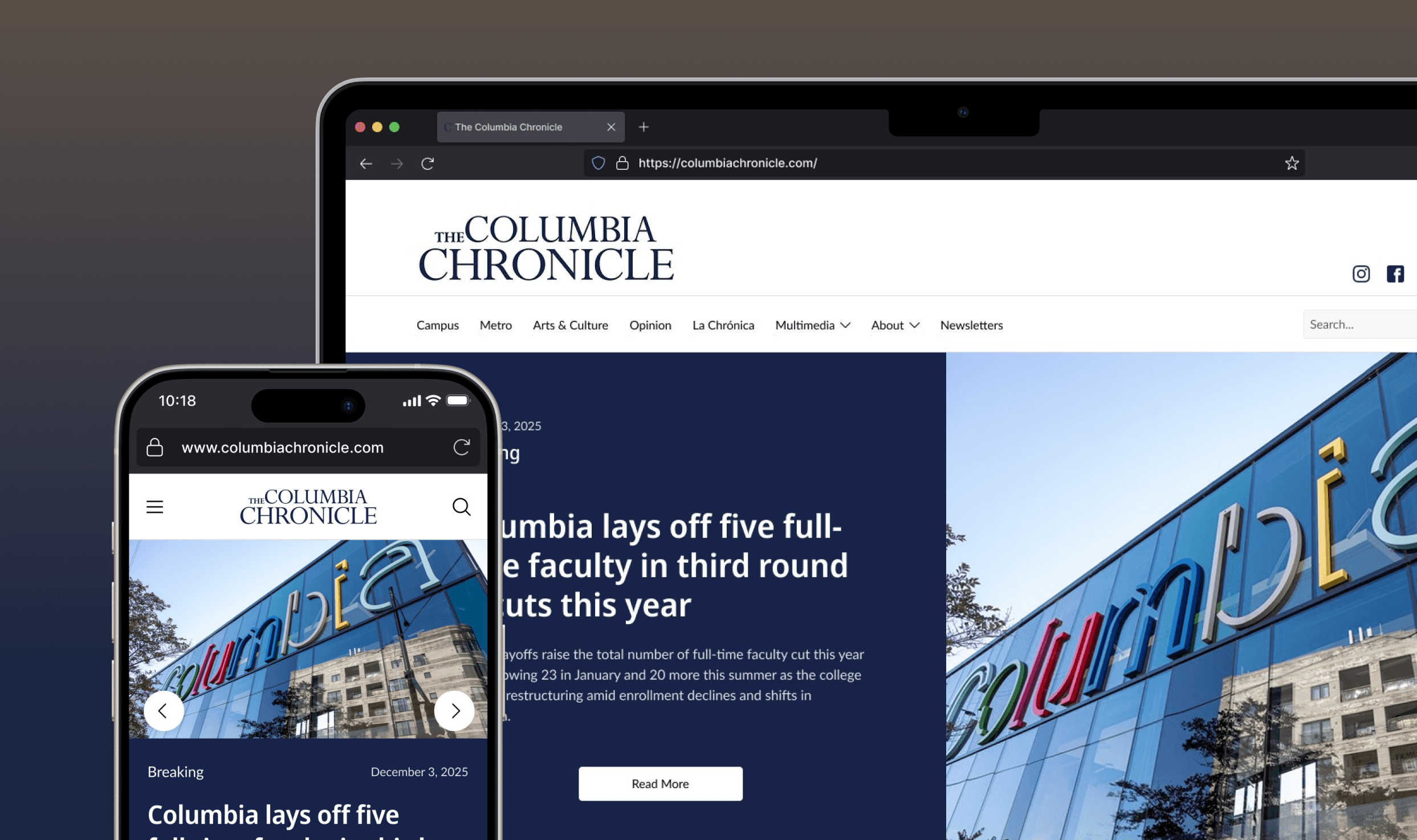
Columbia Chronicle Redesign
Award-winning online student newspaper
Date
September 2025 - February 2026
Role
Project Lead
UI/UX Designer
Web Developer & Designer
What I did
User Research
Wireframing
Front-End Development
The Problem
The Columbia Chronicle is the award-winning, student-led publication of Columbia College Chicago. For over 40 years, the Chronicle has provided the student body with a wide variety of stories covering Columbia’s campus, the South Loop area, and beyond.
When the Chronicle first approached my team and me, they came in with the idea of building a mobile app. Instead of jumping straight into designing, I decided to step back and analyze the state of the publication in context with its primary audience.
Despite having a consistent publication schedule and a growing social media presence, the Chronicle was struggling to reach the students it served. Many students were simply unaware that the Chronicle existed, and those who did know about it often felt like the coverage didn't reflect their interests. The Chronicle had the foundation built, but their current solutions weren’t landing with the students it was trying to reach.
User Research
Before jumping into solutions, I needed to understand the core of the Columbia Chronicle’s primary audience.
I started by defining stakeholders and hearing their perspectives.
Defining User Groups
The Columbia Chronicle’s audience covers a wide range of demographics, from students and parents to alumni and faculty. In addition, the Chronicle also serves its student staff members as a vehicle for professional experience.
I decided to focus on the student body as primary users, as they make up the Chronicle’s primary audience, while keeping the Chronicle’s staff members in mind as secondary users.
Current students, age 18-24
Columbia College Chicago students are the Chronicle's primary readers. They turn to the Chronicle to stay informed on campus news, local events, and the creative work happening around their community.
Columbia Chronicle staffers
As prospective journalists, the Columbia Chronicle's staff are learning the field through real-world experience. They use the Chronicle as a hands-on environment to develop professional skills across writing, editing, design, and more.
User Survey
I created a user survey to achieve a comprehensive understanding of the student body and their perceptions surrounding The Columbia Chronicle. This included exploring their habits, preferences, needs, and expectations.
By analyzing responses from students across multiple majors and disciplines, I identified four major insights:
01
They primarily access news outlets on their smartphones and often get their news through social media.
02
They often receive critical news about the school via word of mouth from peers and faculty members.
03
While many students reported politics and entertainment as important topics they follow, they are most interested in critical and breaking coverage of the school, as well as event coverage and student life.
04
They agreed that the Chronicle does well in covering what’s happening around campus, but want to see better coverage on under-represented programs like game design and interior design.
Staff Interviews
In addition to hearing the perspectives of students, I also had the opportunity to speak with two senior staff members at the Columbia Chronicle in order to get a better idea of their publication process and content strategy, strengths and weaknesses, and their own understanding of their audience.
I came away from this conversation with these insights:
01
They seek a solution that both pushes the Chronicle in front of their target demographic and expands their reach.
02
They identified that an effort in grassroots initiatives can increase awareness and readership.
03
They emphasize social media as a popular and accessible way for students to get their news, as it helps foster engagement and discussion.
The Opportunity
How might we build community and engagement between students and the Columbia Chronicle through better digital access and on-campus awareness?
Coming out of student surveys, staff interviews, and a deep look into the Chronicle's social media channels and peer publications across the country, a few clear patterns emerged. I decided to pursue two directions that worked together to address both sides of the problem: improving the Chronicle’s current website and growing their audience around it.
Website Redesign
Most students access news on their phones and first encounter the Chronicle through social media. The redesign focused on a mobile-first experience that made the jump from a social media post to a full article as smooth as possible, while giving the site a cleaner, more modern look that felt worth coming back to.
Audience Growth Strategy
A lot of students still find out about campus news through word of mouth, which points to an awareness problem more than a content one. This direction focused on grassroots and print marketing initiatives to get the Chronicle in front of students to establish a well-integrated presence in campus life.
Ideation
Brainstorming strategies that promote audience growth and awarenes
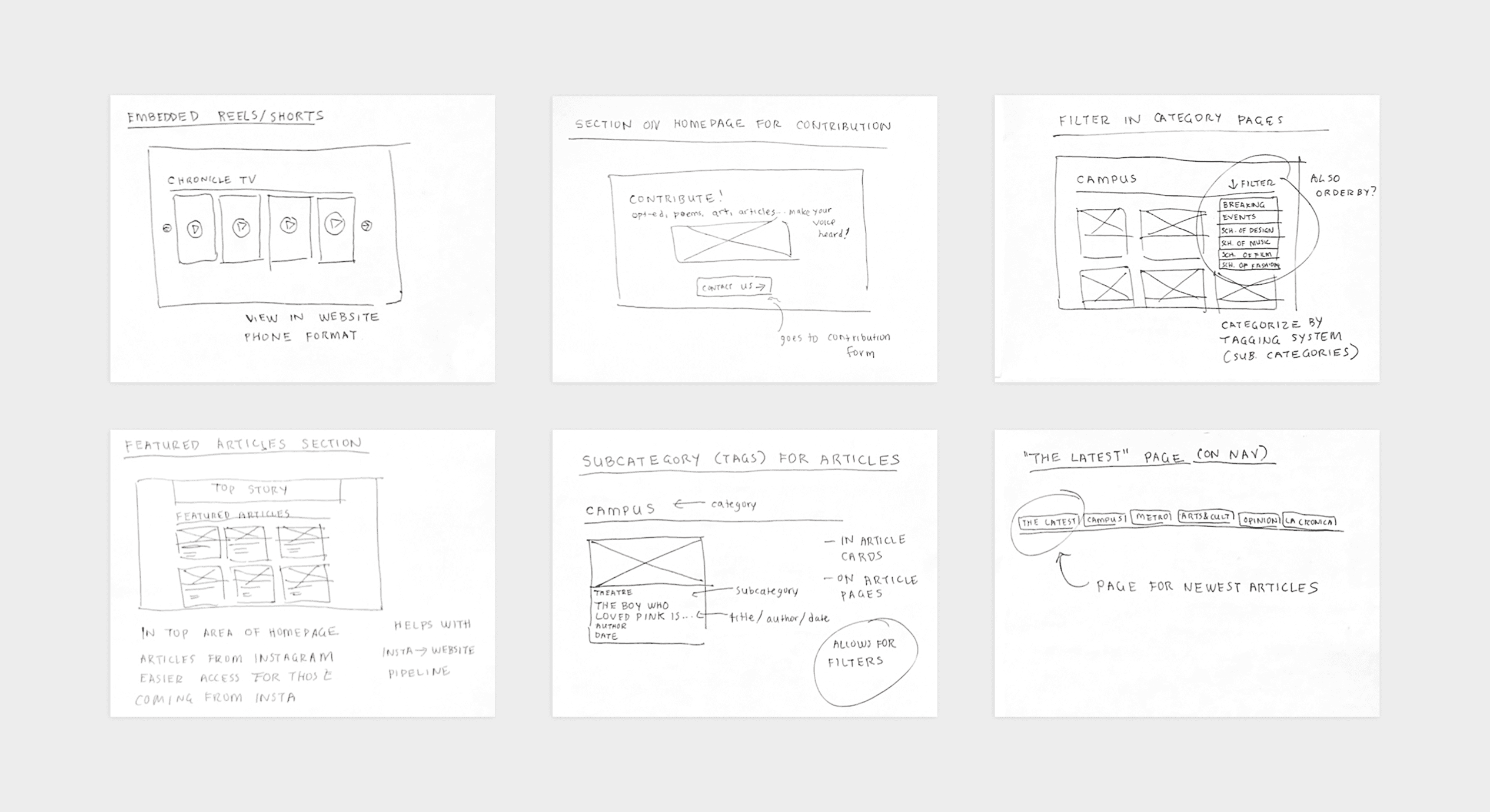
With these insights in mind, I facilitated brainstorming discussions and activities, including Crazy 8’s, to generate both digital-based and community-driven ideas.

By mapping ideas against a scale of feasibility and urgency on a priority matrix, I prioritized the most effective features in scope.
Design
Structure, Layout, and Style
Information Hierarchy
Revising informational hierarchy to support user interests
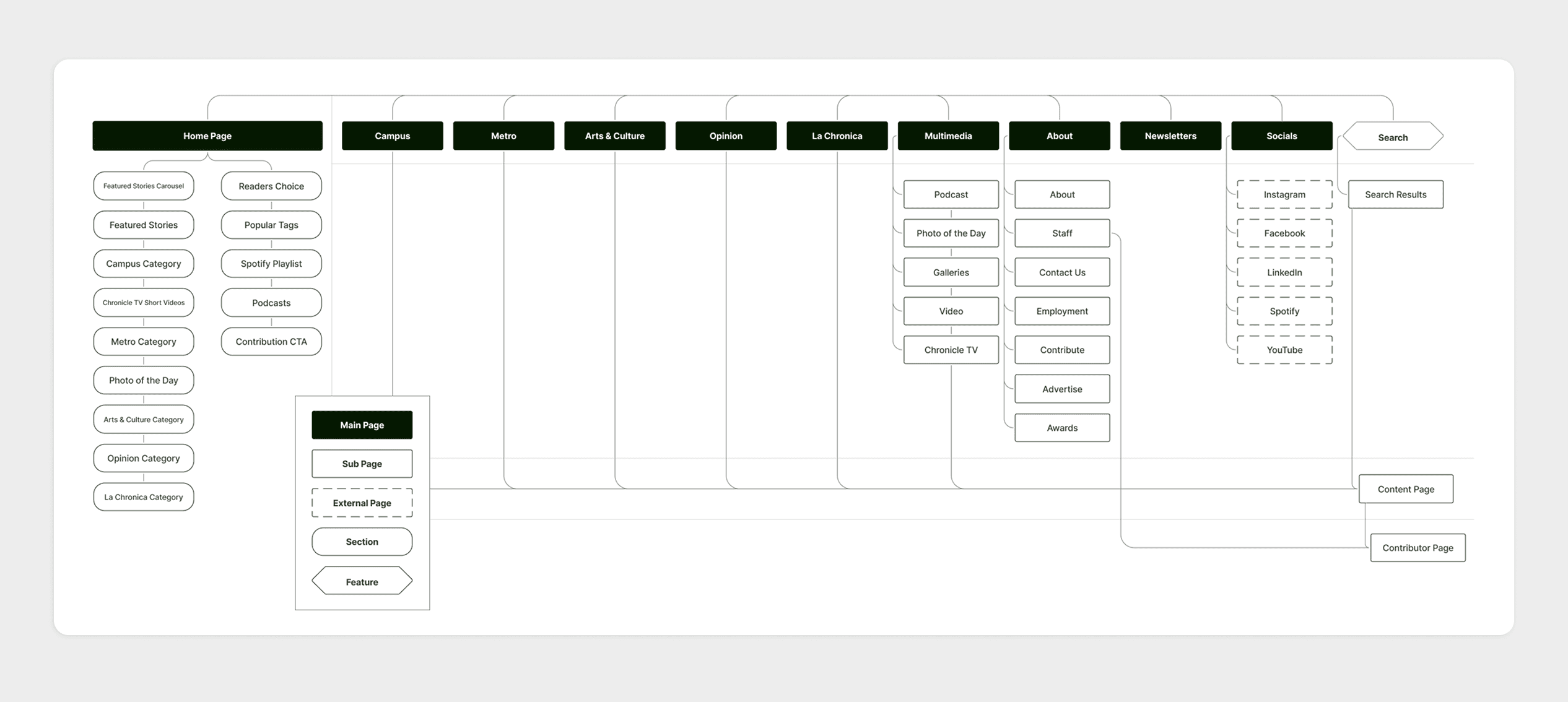
Based on prior research insights, I organized the navigational bar and homepage structure to match sections that student readers found the most important. I also ensured that desired yet hard-to-reach pages, such as the submissions page for op-eds and artwork, were visible and easy to navigate to.
Some notable changes in the navigation include:
Moved the audience’s most read topics, “Campus” and “Metro,” up front
Added a “Contribute” page under the “About” navigation tab, which was previously hidden

Wireframing
Pinpointing key user flows through mid-fidelity wireframing
While my approach to the website's wireframes was mobile-first, I created both mobile and desktop wireframes to support the full range of how readers and staff would interact with the site, as well as to ensure the layout translated clearly during developer handoff.
A big part of the wireframing process was mapping out the different ways users could land on the site. Since students most commonly found the Chronicle through social media or a shared link, I designed entry points that accounted for multiple paths in. I also made sure moving between stories felt natural, with recommended and related articles built into each story page.

Interface Design
Strategy for a refreshed UI
I decided to keep the core of the Chronicle's existing brand while updating the UI to feel more modern and in line with the progressive nature of the student body. Part of that meant replacing the site's heavy reliance on serif fonts with sans-serif typefaces for headers and body text, improving readability and accessibility without losing the site's editorial credibility.
The Final Solution
The Columbia Chronicle Website Redesign
Navigation & Article Carousel
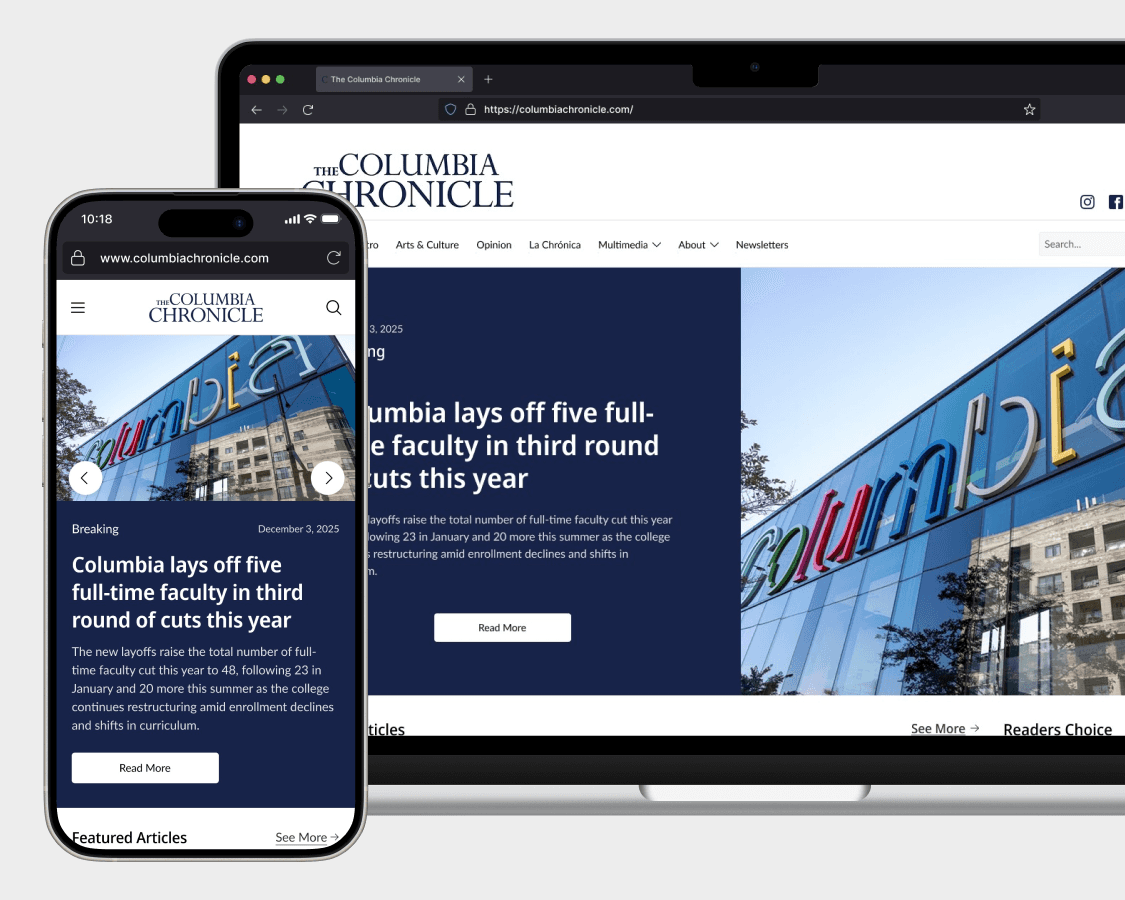
The reconfigured navigation bar features a streamlined design and a navigational hierarchy that aligns with what student readers look for the most.
Replacing the “top story” hero section is an interactable, rotating carousel of featured stories. This feature makes for a more engaging experience and allows for multiple articles to be featured in the same amount of space.
Tagging and Filtering System
In order for readers to easily find topics that interest them, a lightweight story tagging system is featured in story cards, story and category pages, and as selectable buttons on the homepage for filtering.
These tags include the Chronicle’s five main sections, as well as subtopics such events, campus life, previews and reviews, politics, and specific schools.

Featured Articles
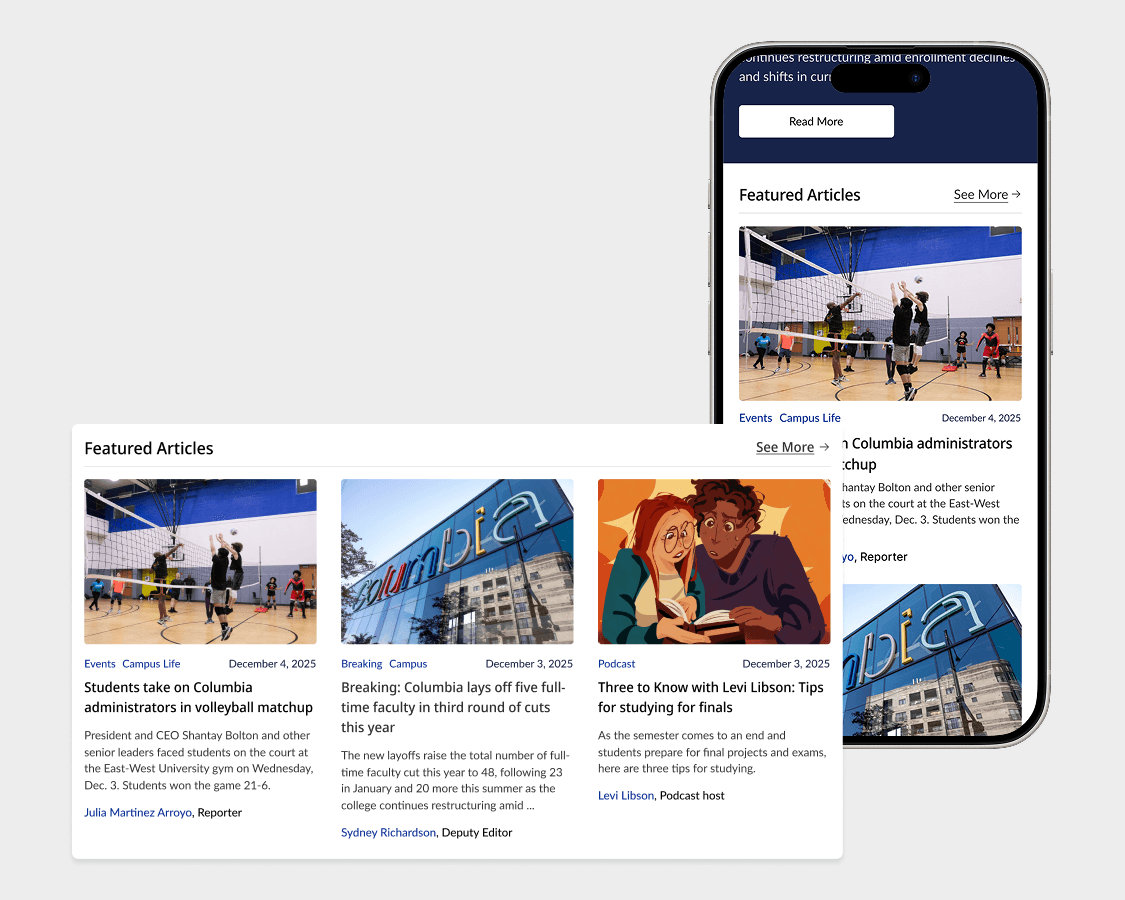
In order to streamline the social media → website pipeline, a Featured Articles section is included near the top of the homepage for stories that have been posted on the Chronicle’s social media channels. Minimal scrolling required!

Highlighting Chronicle TV
To better emphasize the Chronicle’s efforts on social media, a redesigned Chronicle TV section of the homepage is featured with a carousel of the latest shorts/reels in the common short-form media aspect ratio.
Contribution Call-To-Action
This call-to-action element highlights contribution information for student creatives, giving basic information about the kinds of submissions the Chronicle accepts, increasing awareness about featured student perspectives.

The Final Solution
Community Engagement Campaign
In addition to the website redesign, I highlighted some ways the Columbia Chronicle team could take grassroots initiatives to meet the student body on campus, including:
Handing out print editions on campus
Getting physical copies directly into students' hands is a straightforward way to build awareness, meeting them in the spaces they already frequent throughout the day.
Multimedia on campus displays
Running Chronicle content on monitors in campus buildings is a low-effort, high-visibility way to keep the publication in front of students who might not seek it out on their own.
Expanding coverage of underrepresented programs
Broadening the Chronicle's coverage would directly address the readership gap and give more of the student body a reason to engage in what they’re passionate about.
Web Development
Catching the website up to speed
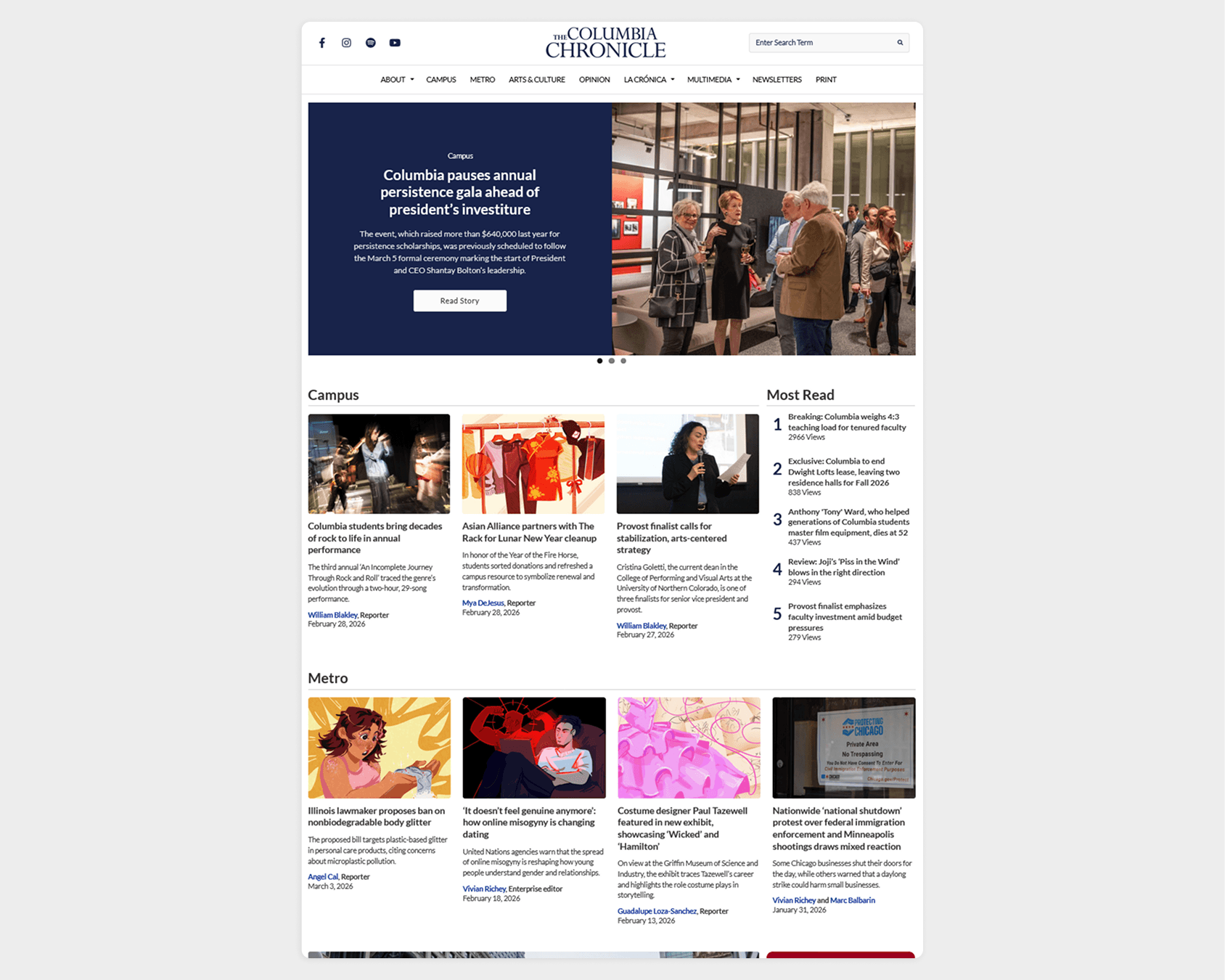
Through January and February, I was brought on as a web developer to help bring the redesign to life. Working directly in WordPress with custom CSS and plugins, I built out and refined key parts of the site, making sure what shipped was functional, consistent, and close to the original vision wherever the platform allowed.
That said, the live site doesn't fully match the prototype. WordPress and the Chronicle's existing plugin infrastructure placed real constraints on what could be implemented, and some features, like the tagging system, were dependent on editorial decisions that weren't finalized in time. The redesign represents the full vision; the live site reflects what was feasible within those constraints.